
Welcome to the Jan C. Willems Center for Systems and Control at the University of Groningen. On this site you will find information about the research activities, projects and experts in the field of Systems and Control in Groningen.
ERC Starting Grant for Henk van Waarde
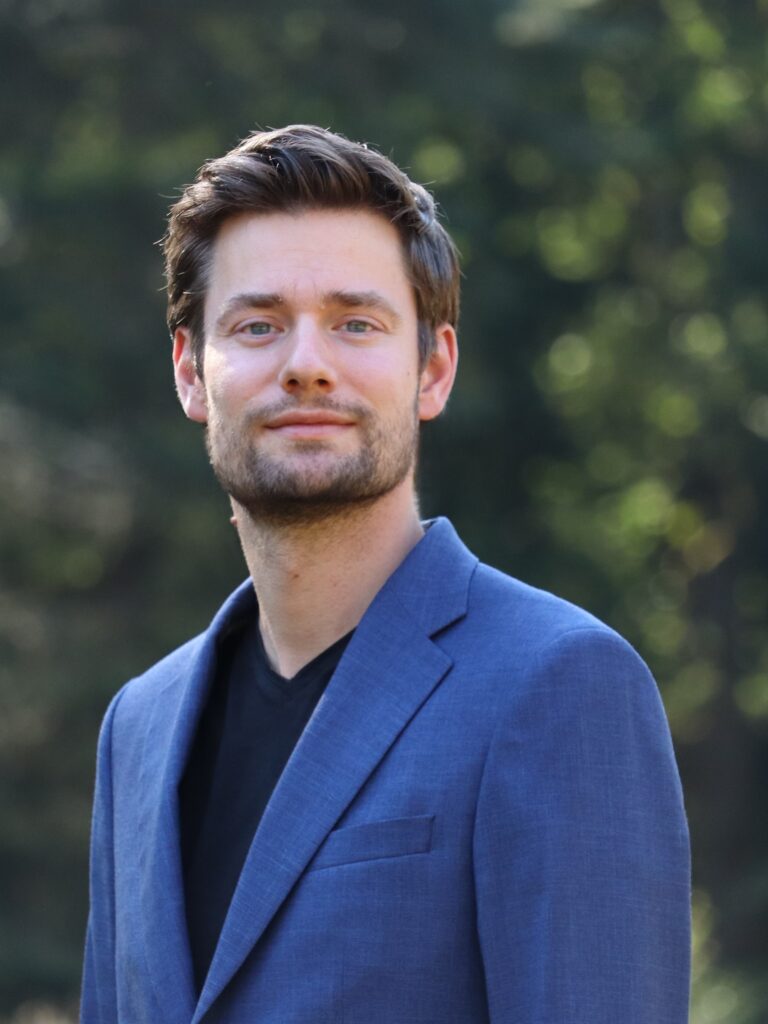
Henk van Waarde has been awarded an ERC Starting Grant (€1.5 million) for his research proposal `Energy-based learning of complex dynamical systems (E-BLOCS)’. The project aims to contribute to the mathematical foundations of physics-based learning and help pave the way towards more energy-efficient computing technologies.
FSE PhD Supervisor of the Year 2026 for Stephan Trenn
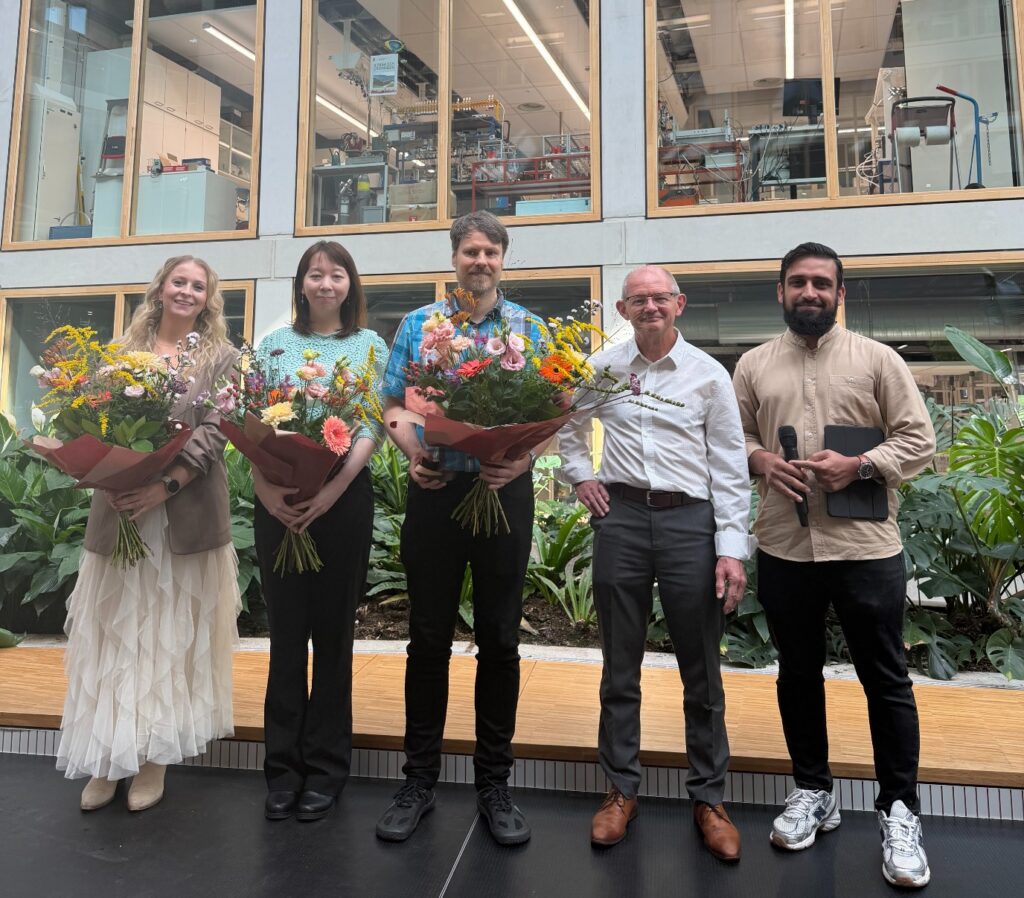
Dr. Stephan Trenn has been awarded the PhD Supervisor of the Year Award 2026.
From 2018 onwards, the PhD Council, in collaboration with the sounding board, annually awards the PhD Supervisor of the Year Award within the Faculty of Science and Engineering. The PhD students of the Faculty are invited to nominate their supervisor for their outstanding supervisory practices. Based on the feedback and praise provided by the students, the finalists and winner are chosen by voting by the PhD Council.
The selection of the finalists and the winner is done by the Council, based on the feedback provided by those students. This year, they received 26 unique nominations out of which the 3 finalists were selected. The winner was announced during the Faculty Opening of the Academic Year on Monday, August 31.
Shaoxuan Cui receives ECC 2026 Outstanding Student Paper Award
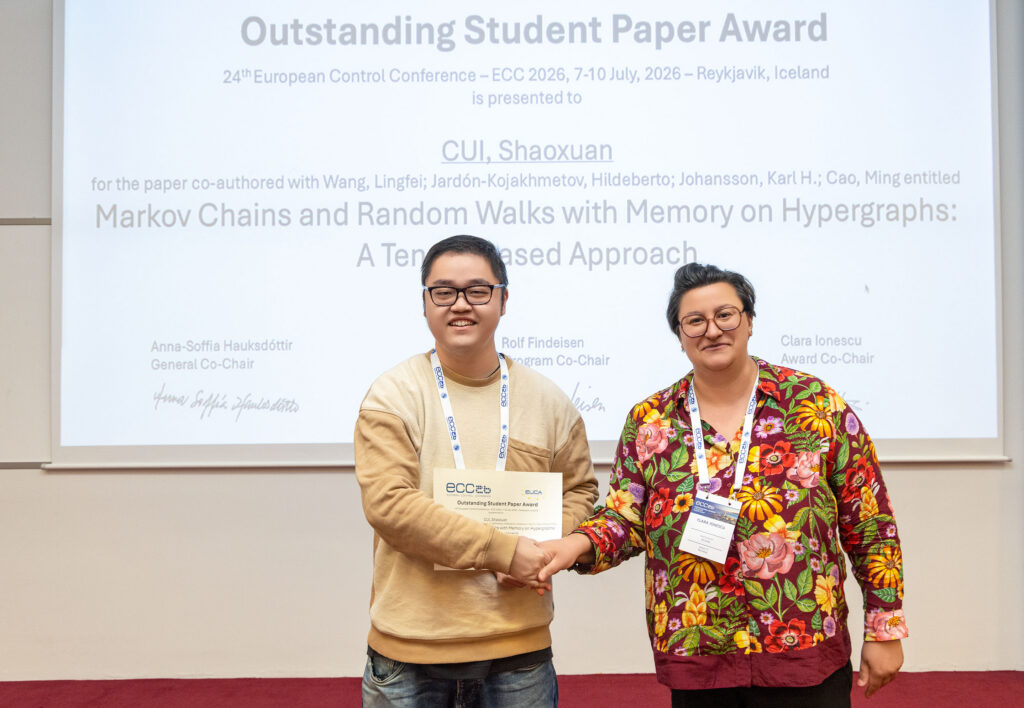
Dr. Shaoxuan Cui has been awarded the Outstanding Student Paper Award at the 24th European Control Conference (ECC 2026), held in Reykjavík, Iceland, from July 7 to 10, 2026. The award recognizes his paper, “Markov Chains and Random Walks with Memory on Hypergraphs: A Tensor-Based Approach”, co-authored with Lingfei Wang, Hildeberto Jardón-Kojakhmetov, Karl H. Johansson, and Ming Cao.
At the time of submission, Dr. Cui was a PhD candidate at the University of Groningen, jointly supervised by Prof. Ming Cao from the Engineering and Technology Institute Groningen (ENTEG) and Dr. Hildeberto Jardón-Kojakhmetov from the Bernoulli Institute for Mathematics, Computer Science, and Artificial Intelligence. He completed his PhD in March 2026 and is currently a postdoctoral researcher collaborating with Prof. Cao.
The awarded paper introduces a unified tensor-based framework for modeling Markov chains with memory and random walks on hypergraphs. It provides novel analytical tools for studying the steady-state and convergence properties of complex network processes, addressing both higher-order interactions and memory effects.
UvhN team wins RDW Self Driving Challenge
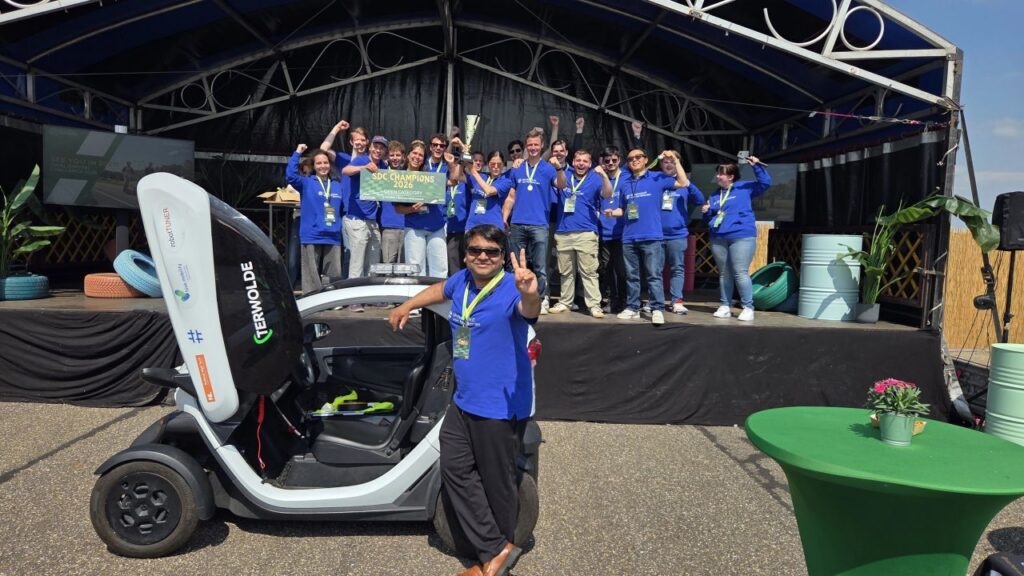
The Universiteit van het Noorden (UvhN) team lead by University of Groningen along with Hanze and Noorderpoort is the new National Champion of the 2026 RDW Self Driving Challenge. The team was supervised by Saeed Ahmed and the student leader was our MSc Systems and Control student Medya Badakhshani.
Martina Vanelli joins SMS group

On June 1, 2026, Dr. Martina Vanelli started a position as a tenure-track Assistant Professor within the Smart Manufacturing Systems (SMS) group at the Engineering and Technology Institute Groningen (ENTEG) at the University of Groningen. Her research focuses on the modeling, design, and control of multi-agent and networked systems, primarily with applications to energy markets and social and economic networks.
She received the B.Sc., M.Sc. (cum laude), and Ph.D. (with honors) degrees in Applied Mathematics from Politecnico di Torino, Italy, in 2017, 2019, and 2024, respectively. Her doctoral research, co-funded by Machine Learning Reply, focused on game-theoretic models for electricity markets. From February 2024 to May 2026, she was a postdoctoral fellow at the ICTEAM Institute of UCLouvain, Belgium, where she worked on nonlinear network identification and data-driven control.
Jacquelien Scherpen and Arjan van der Schaft elected as EUCA Fellow 2026
The EUCA Fellow award has been initiated ‘to recognize persons who have made outstanding contributions and accomplishments in the field of interest of the European Control Association (EUCA)’. The first round of awards takes place in 2026 and comprises ten awards. Jacquelien Scherpen and Arjan van der Schaft are proud to be selected for this first class of EUCA fellows.
FARMLAB project funded by €2 million

FARMLAB, led by the University of Groningen researchers Saeed Ahmed and Bayu Jayawardhana, has been awarded €2 million from the NWO (Dutch Research Council) NXTGEN Hightech programme.
Together with Wageningen University & Research, TNO, Saxion University of Applied Sciences, and industry partners Green Dino, SMI Dokkum, Batenburg Beenen, DEMCON industrial systems, and ABdrone, the consortium will develop autonomous drones and ground robots for precision and regenerative agriculture, with real-world testing and national scaling ahead.
For more information see the university announcement.
Jaap Eising joins DTPA group

On January 1, 2026, Dr. Jaap Eising started his position as a Tenure Track Assistant Professor of AI in Control within the DTPA group. His research interests are understanding and designing learning architectures, aiming at the development of new data-based control methods for hard to model systems.
Jaap earned his MSc and PhD in Mathematics from the University of Groningen in 2017 and 2021 respectively. His doctoral thesis focused on the analysis of conically constrained dynamical systems and fundamentals of data-driven controls. Followed by the PhD was a position as postdoctoral researcher at UC San Diego, working on both data-based control and optimization. After this a he moved to ETH Zurich, where he became a senior scientist, expanding towards the links between controls, machine learning and algorithm design.
IFAC High Impact Paper Award for Arjan van der Schaft
Arjan van der Schaft together with his coauthors Romeo Ortega, Bernhard Maschke and Gerardo Escobar have been awarded the High Impact Paper Award 2026 for their paper “Interconnection and damping assignment passivity-based control of port-controlled Hamiltonian systems” which appeared in Automatica, Vol. 38, pp. 585-596, April 2002.
This paper marks the start of the theory of nonlinear passivity-based control of physical systems represented in port-Hamiltonian form. Characteristic feature of this theory, and of its applications in various physical domains, is that the obtained control laws are often intrinsically robust and have a direct physical interpretation in terms of energy. The paper received around 2000 quotations according to Google Scholar.
The presentation of the award will take place in the framework of the Opening Ceremony at the Busan IFAC World Congress on Sunday, 23 August 2026. This award is one of IFAC’s major awards and consists of a medal, certificate and prize money.
Bart Besselink receives ERC Consolidator Grant
The research proposal “Contracts for Control System Design (COCOS)” of Bart Besselink will receive 2 Mio € funding by the European Research Council (ERC). The ERC Consolidator Grant is a prestigious research funding program to support researchers who are in the early stages of their independent research careers and have demonstrated significant potential for conducting high-quality research. Bart proposes a new approach for control system design based on contracts, inspired by ideas from software design in computer science. He will develop a contract theory for control system design that includes techniques for the automatic design of component contracts aimed at optimizing system-level performance, and control design for contract satisfaction. The practical relevance of the theory will be tested by case studies in high-tech manufacturing systems and autonomous vehicles, and supported by efficient computational tools.