The award citation recognises Van der Schaft for contributions to robust and geometric approaches to nonlinear control, hybrid systems, and the control of physical systems.
He is the first Dutch recipient of the award and after Jan C. Willems in 1998 the second researcher associated with the University of Groningen to receive it.
Henk van Waarde has been awarded an ERC Starting Grant (€1.5 million) for his research proposal `Energy-based learning of complex dynamical systems (E-BLOCS)’. The project aims to contribute to the mathematical foundations of physics-based learning and help pave the way towards more energy-efficient computing technologies.
Dr. Stephan Trenn has been awarded the PhD Supervisor of the Year Award 2026.
From 2018 onwards, the PhD Council, in collaboration with the sounding board, annually awards the PhD Supervisor of the Year Award within the Faculty of Science and Engineering. The PhD students of the Faculty are invited to nominate their supervisor for their outstanding supervisory practices. Based on the feedback and praise provided by the students, the finalists and winner are chosen by voting by the PhD Council.
The selection of the finalists and the winner is done by the Council, based on the feedback provided by those students. This year, they received 26 unique nominations out of which the 3 finalists were selected. The winner was announced during the Faculty Opening of the Academic Year on Monday, August 31.
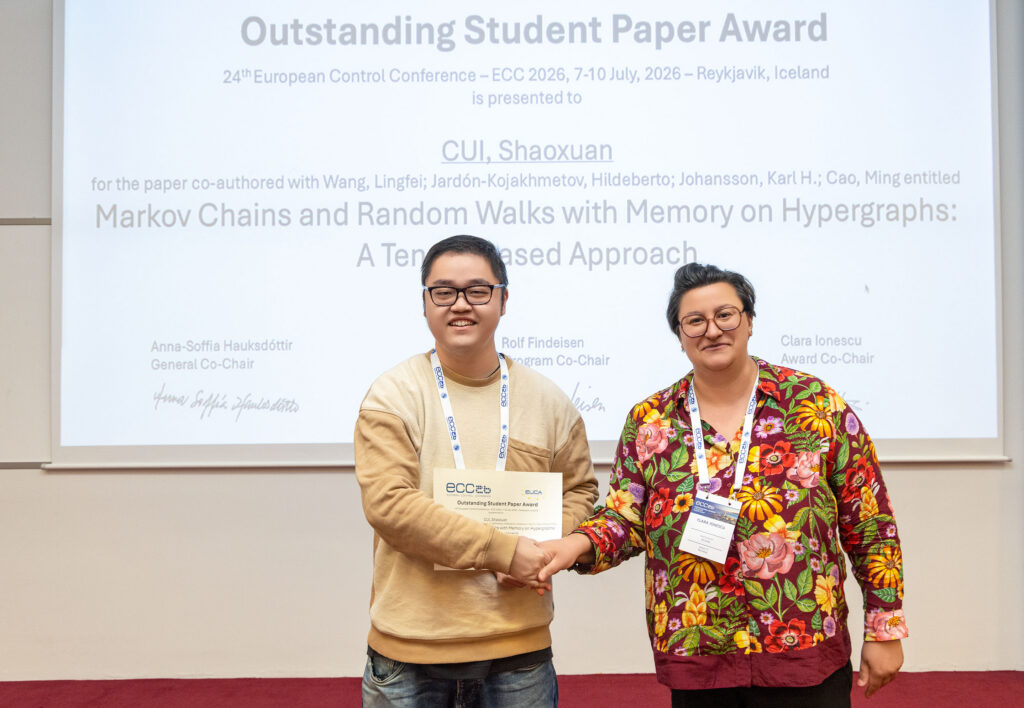
At the time of submission, Dr. Cui was a PhD candidate at the University of Groningen, jointly supervised by Prof. Ming Cao from the Engineering and Technology Institute Groningen (ENTEG) and Dr. Hildeberto Jardón-Kojakhmetov from the Bernoulli Institute for Mathematics, Computer Science, and Artificial Intelligence. He completed his PhD in March 2026 and is currently a postdoctoral researcher collaborating with Prof. Cao.
The awarded paper introduces a unified tensor-based framework for modeling Markov chains with memory and random walks on hypergraphs. It provides novel analytical tools for studying the steady-state and convergence properties of complex network processes, addressing both higher-order interactions and memory effects.
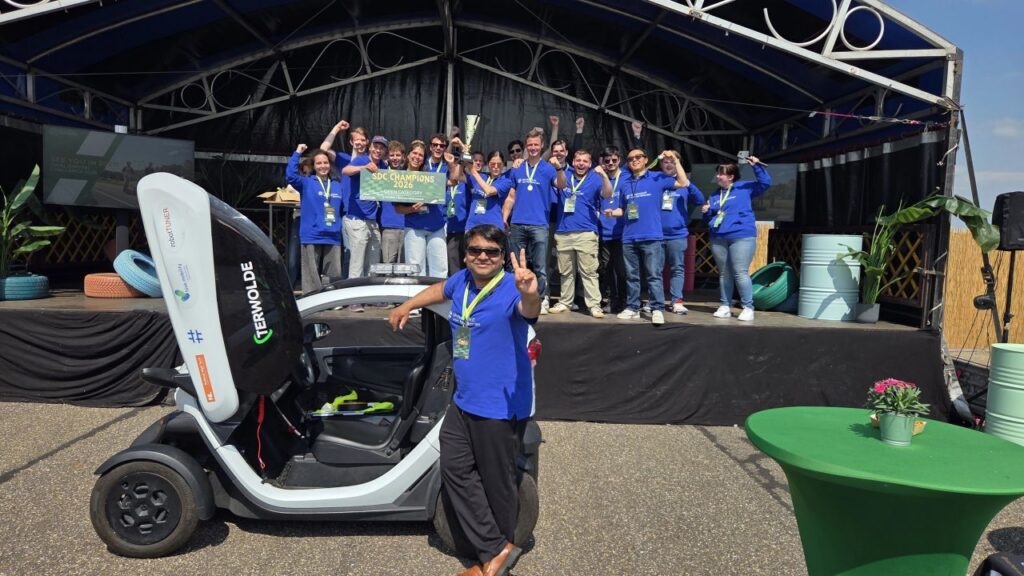
The Universiteit van het Noorden (UvhN) team lead by University of Groningen along with Hanze and Noorderpoort is the new National Champion of the 2026 RDW Self Driving Challenge. The team was supervised by Saeed Ahmed and the student leader was our MSc Systems and Control student Medya Badakhshani.
The EUCA Fellow award has been initiated ‘to recognize persons who have made outstanding contributions and accomplishments in the field of interest of the European Control Association (EUCA)’. The first round of awards takes place in 2026 and comprises ten awards. Jacquelien Scherpen and Arjan van der Schaft are proud to be selected for this first class of EUCA fellows.
FARMLAB, led by the University of Groningen researchers Saeed Ahmed and Bayu Jayawardhana, has been awarded €2 million from the NWO (Dutch Research Council) NXTGEN Hightech programme.
Together with Wageningen University & Research, TNO, Saxion University of Applied Sciences, and industry partners Green Dino, SMI Dokkum, Batenburg Beenen, DEMCON industrial systems, and ABdrone, the consortium will develop autonomous drones and ground robots for precision and regenerative agriculture, with real-world testing and national scaling ahead.
This paper marks the start of the theory of nonlinear passivity-based control of physical systems represented in port-Hamiltonian form. Characteristic feature of this theory, and of its applications in various physical domains, is that the obtained control laws are often intrinsically robust and have a direct physical interpretation in terms of energy. The paper received around 2000 quotations according to Google Scholar.
The presentation of the award will take place in the framework of the Opening Ceremony at the Busan IFAC World Congress on Sunday, 23 August 2026. This award is one of IFAC’s major awards and consists of a medal, certificate and prize money.
The research proposal “Contracts for Control System Design (COCOS)” of Bart Besselink will receive 2 Mio € funding by the European Research Council (ERC). The ERC Consolidator Grant is a prestigious research funding program to support researchers who are in the early stages of their independent research careers and have demonstrated significant potential for conducting high-quality research. Bart proposes a new approach for control system design based on contracts, inspired by ideas from software design in computer science. He will develop a contract theory for control system design that includes techniques for the automatic design of component contracts aimed at optimizing system-level performance, and control design for contract satisfaction. The practical relevance of the theory will be tested by case studies in high-tech manufacturing systems and autonomous vehicles, and supported by efficient computational tools.
Henk van Waarde has received an NWO Veni grant for his proposal “Kernel-based control theory of nonlinear systems”. Veni grants are part of the Talent Scheme by the Dutch Research Council. They are awarded to talented early-career researchers who have obtained their PhD in the last three years.